Queering the Law
Beyond Supriyo
In 2019, the Vidhi Centre for Legal Policy published, ‘Queering the Law: Making Indian Laws LGBT+ Inclusive’, a set of five Chapters that analyses India’s legal regime across the broad themes of ‘Identity’, ‘Violence’, ‘Family’ and Employment in light of landmark judgements of the Supreme Court in cases such as NALSA v. Union of India, and Navtej Johar v. Union of India.
In 2023, the Supreme Court of India, in Supriyo v. Union of India, while denying marriage equality to certain sections of the queer community, directed the State to set up a High Powered Commission to identify and address the discrimination that queer persons face on account of their gender identity/sexual orientation, and non-recognition of their relationships. Vidhi and the Keshav Suri Foundation collaborated to make joint submissions to to the Committee outlining legislative and executive measures the State can take to recognise rights of queer persons across four core areas: relationships and family, discrimination in access to goods and services, queer affirmative healthcare, and prohibition and rehabilitation from violence. These submissions were informed by public consultations attended by around 150 stakeholders including queer civil society, lawyers, activists, academics, amongst others.
Based on the submissions to the Committee, KSF and Vidhi have finalised four policy briefs titled ‘Queering the Law: Beyond Supriyo’. These simple and accessible policy briefs outline law and policy measures that the State can undertake to recognise rights of the community across four key areas: families, discrimination, healthcare and violence.
The objective of these briefs is to aid advocacy and strategic litigation efforts by queer civil society and allied stakeholders to push for queer inclusive law reform at both the Union and State level. They hope to serve as a resource for debate, deliberation and strategy building, while outlining potential interventions across identified sectors.
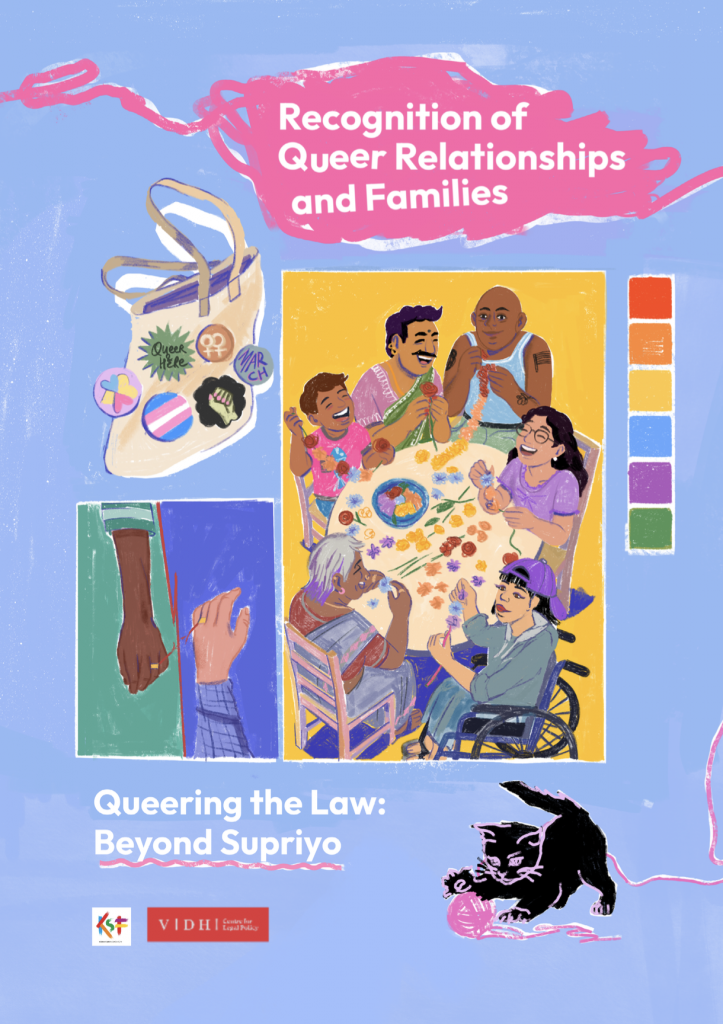
Recognition of Queer Relationships and Families
This policy brief addresses the need for legal recognition of queer families and relationships. Part A focuses on relationships between parties and recognition of a variety of family structures in law. Part B on parent-child relations, recommends amendments to the secular law on adoption to make them queer inclusive and suggests targeted measures for reform of laws governing parenthood to make them modern and inclusive of atypical families.
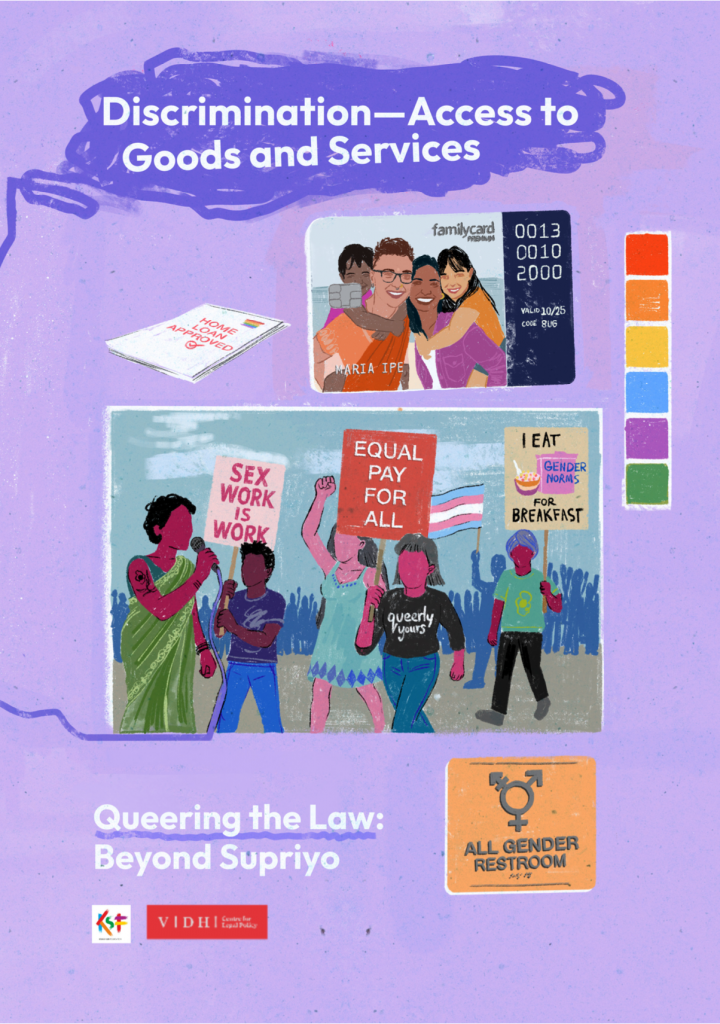
Discrimination in Access to Goods and Services
This policy brief makes recommendations to address the discrimination queer persons face. Part A recommends general measures such as a comprehensive anti-discrimination law and reforms to the Transgender Persons (Protection of Rights) Act, 2019. Part B recommends sector specific recommendations across four sectors: financial services, employment, education, and housing. Recommendations are directed towards both prohibition of discrimination as well as affirmative measures to address systemic exclusion.

Queer Affirmative Healthcare
This policy brief captures wide-ranging recommendations spanning combatting existing discriminatory practices in healthcare, introducing affirmative healthcare, and affecting systemic measures. The removal of existing discrimination includes banning conversion therapy and medically unnecessary intersex surgeries, and ensuring compliance with the law on anti-discrimination against persons living with HIV-AIDS. Recommended affirmative measures include the provision of gender-affirming treatment, affordable mental health support, queer-inclusive health research, and provision for nomination of healthcare representatives of choice. Systemic measures include making health laws queer-inclusive, and increasing the presence of queer-affirmative healthcare workers through improved training and modified curricula, as well as horizontal reservations in public healthcare.
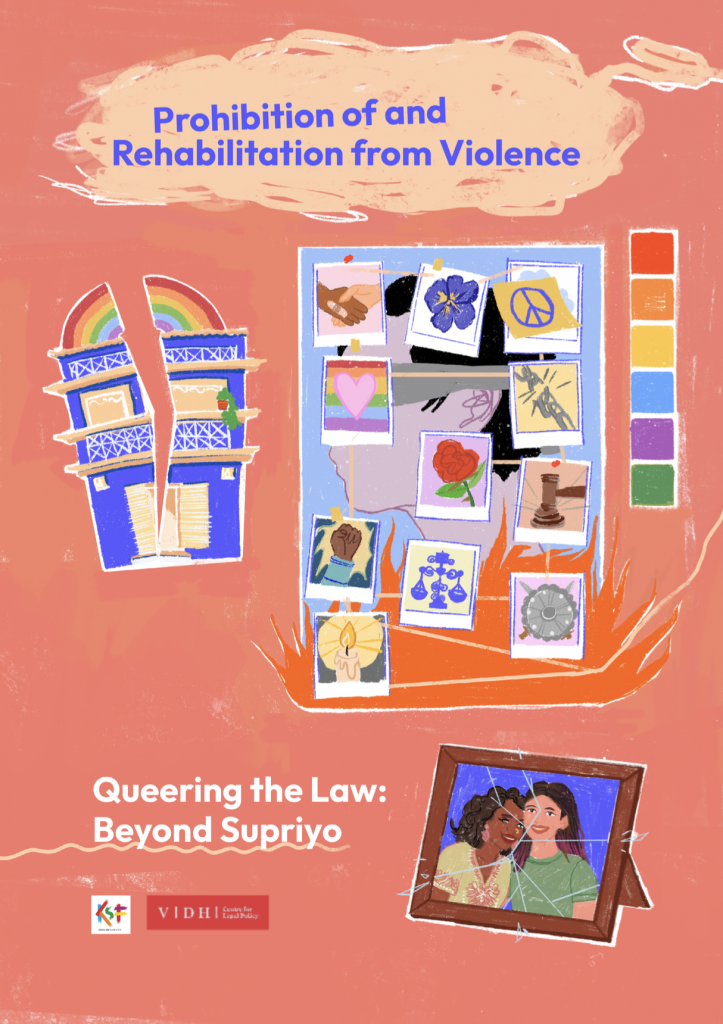
Prohibition of and Rehabilitation from Violence
This policy brief addresses violence propagated by the State and society at large, by the natal family, and domestic and sexual violence. It recommends reforms in law enforcement including police sensitisation, amended police rules and binding directions. Proposed affirmative measures for rehabilitation from violence include shelter homes and emergency helplines. Legislative changes have been suggested to protect queer persons and persons in queer relationships from sexual, domestic and intimate partner violence as well as workplace harassment.
Filed Under
About the Authors

Aashna is a Research Fellow with the Criminal Justice team at Vidhi. Having recently completed their B.A., LL.B. (Hons.) from Symbiosis Law School, Pune, they are keenly interested in Constitutional, Administrative, and Criminal Law. Outside of professional engagements, Aashna finds their greatest joy in animals and food, and also enjoys music, competitive parliamentary debate, and political and historical fiction.

Jwalika is a Senior Resident Fellow in the Research Director's Office at the Vidhi Centre for Legal Policy, Delhi. She holds a Bachelor of Civil Law (LLM-equivalent) degree from the University of Oxford and a BA LLB (Hons) from the National Law School of India University, Bangalore. Her areas of interest include family law, equality and anti-discrimination law, and human rights, with a special emphasis on gender and sexuality. She is on the Board of Directors at OutLawed India, a not-for-profit organisation working to improve access to law and justice. At Vidhi, she has been providing legislative drafting assistance to various Ministries, Departments, and Authorities of the Central Government and various State Governments.

Kartavi is a Senior Resident Fellow working with the Legal Design and Regulation Team. She completed her B.Sc. LLB (Intellectual Property Hons.) from National Law University Jodhpur in 2018 and obtained her LLM degree from National University of Singapore in 2022. Prior to joining Vidhi, she also worked as a Legal Researcher at the Delhi High Court where she worked on matters ranging from service law and IPR disputes to constitutional law. Her research interests lie in the areas of access to justice, technology policy and digital divide, climate change policy and education. Kartavi also enjoys theatre, cinema and asian literature.

Namrata is a Senior Resident Fellow in the Legal Design and Regulation Vertical at Vidhi. She primarily handles engaged and commissioned projects from various ministries, statutory authorities and regulators by providing legal research and legislative drafting support. At Vidhi, she has worked with the Ministry of Electronics and Information Technology, the Ministry of Economic Affairs, the Ministry of Women and Child Development and the Department of Consumer Affairs. Namrata also works extensively on queer rights and has initiated and worked on numerous projects on rights of gender and sexual minorities. She has written for the Hindu, the Firstpost, the Economic Times, the Leaflet, Article 14, Indian Express and Varta GenSex Policy Matters. Prior to Vidhi, Namrata taught at the Jindal Global Law School and the West Bengal National University of Juridical Sciences (‘NUJS’), worked with the Migration and Asylum Project on labour laws and policy, the Centre for Popular Democracy in New York City, and the Public Law and Vidhi Aid verticals at Vidhi. She has a BA/LLB from NUJS and a LLM from Columbia Law which she attended in the capacity of a Human Rights Fellow

Rakshita was a Senior Resident Fellow with the Health team. Rakshita graduated from National Law University, Jodhpur with a B.A., LL.B. (Hons.). Prior to joining Vidhi, she has worked at the Centre for Policy Research and PRS Legislative Research. Her research areas have involved federal water governance, and health, technology and environment laws. She is broadly interested in understanding the social, political and economic contexts behind the law and how systems can be designed to better fit these contexts.

Shireen Yachu is a Senior Resident Fellow, Health at the Vidhi Centre for Legal Policy. Her work focuses on end-of-life care, advance care planning, suicide prevention & mental health, and gender rights. Prior to joining Vidhi, she worked at the Office of Dr Virander Singh Chauhan on issues of gender rights, health policy, and education. She holds a Master's degree in Sociology from the Delhi School of Economics. Her areas of interest include public health, gender rights, education, and environment.

Sunetra is a Senior Resident Fellow and leads Vidhi's work on Legal Design and Regulation. She primarily handles engaged and commissioned projects from various ministries, statutory authorities and regulators, where she provides legal research and drafting support at various stages of law-making. At Vidhi, she has worked with ministries such as the Ministry of Electronics and Information Technology and the Department of Consumer Affairs. Her current projects at Vidhi include reforms in the area of digital economy, privacy law, data protection as well as healthcare systems and consumer protection. She has also written for The Indian Express and Firstpost. Sunetra graduated with B.A, LL. B (Hons) from NALSAR University of Law, Hyderabad in 2012. Subsequently, she worked at AZB& Partners, Bangalore for two years, where her work primarily involved general corporate matters, employment law and litigation. Thereafter, she obtained her LL.M in Intellectual Property Law from George Washington University, Washington D.C. in 2015.