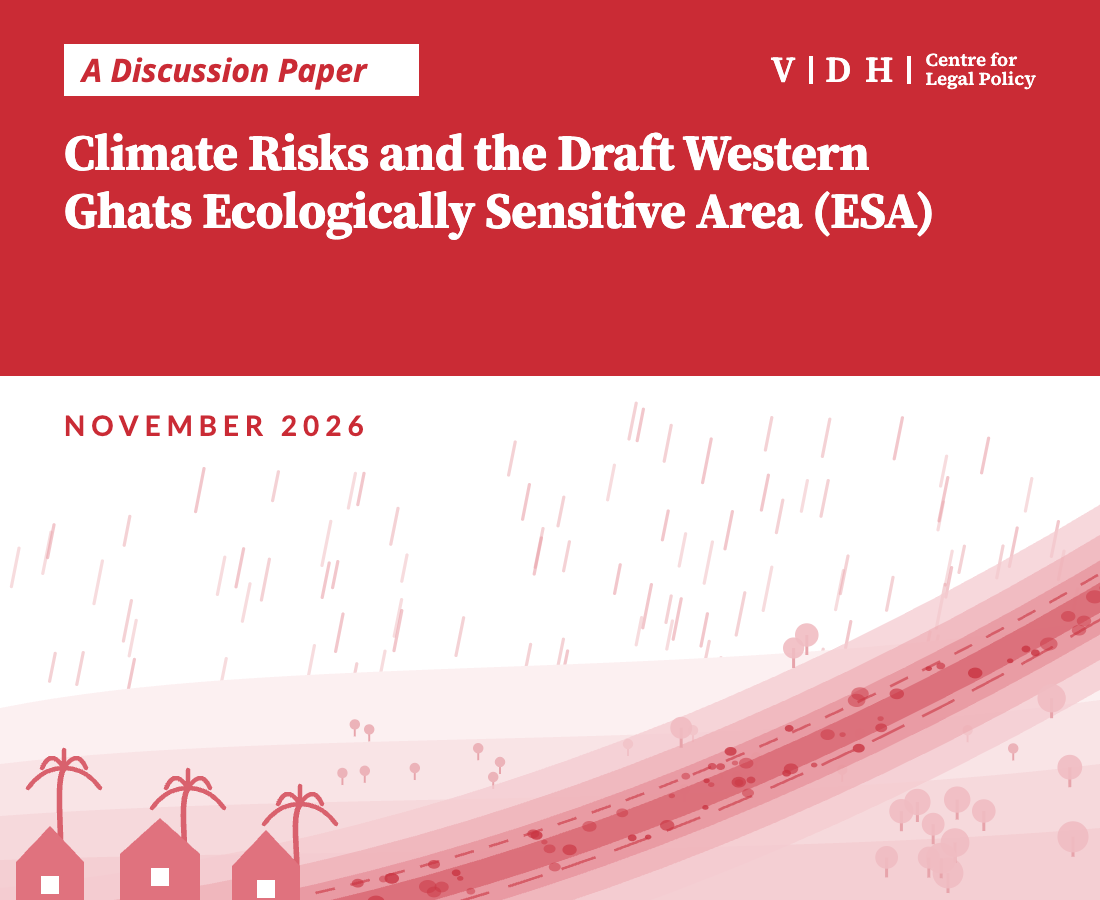
Climate Risks and the Draft Western Ghats Ecologically Sensitive Area (ESA)
This research analyses the climate change related risks in the proposed Western Ghats Ecologically Sensitive Area (WGESA). Drawing on official records and geospatial information, it analyses the historical trends and patterns of landslides, floods and droughts in the region.
On 27 July 2026, the Ministry of Environment, Forests and Climate Change (MoEFCC) published the seventh Draft Notification for declaring the Western Ghats Ecologically Sensitive Area (WGESA) under the Environment (Protection) Act, 1986. It covers an area of 56,825.7 sq km spread across six States – Gujarat, Maharashtra, Goa, Karnataka, Tamil Nadu and Kerala. One of the world’s biodiversity hotspots, the Western Ghats comprise a fragile and sensitive landscape that performs important hydro-ecological functions. The proposal to notify it as an ‘Ecologically Sensitive Area’ is to ensure that human and developmental activities are compatible in the region. However, despite seven such attempts over more than a decade, this is yet to be finalized.
This research of the Climate and Ecosystems Team at Vidhi demonstrates that climate change related risks have become more acute and intense over the years in the proposed area of the WGESA. It shows the historical trends and patterns of landslides, floods and droughts in the region by consolidating official records and geospatial information, analysed at the State and District levels, for the 47 Districts included in the 2026 Draft Notification.
Some of the findings include:
- The Districts in the proposed WGESA are among the most landslide-prone areas in the country, with the issue being most acute in Kerala
- There is a clear pattern of increased flood risks, and the increase in floods in the proposed WGESA Districts is significantly higher than in the rest of India – Districts in the proposed WGESA are also acutely affected by erratic rainfall and droughts, with droughts being felt most intensely in the districts in Karnataka and Maharashtra
This research highlights the need to finalize the WGESA as a measure to mitigate the climate change risks in this fragile and sensitive landscape.
Filed Under
About the Authors

Anandhu P M graduated with a BSc in Zoology from Sacred Hearts College, Kochi, and went on to complete an MA in Development Studies from the Indian Institute of Technology, Guwahati and a Master of Public Policy from the Indian Institute of Technology, Delhi. He has internship experience with a Member of Parliament, where he was directly involved in drafting Private Members' Bills and other parliamentary procedures. His research interests include human-wildlife conflict, environmental law and policy, environmental sociology, and geospatial modelling.

Debadityo is a Senior Resident Fellow and Lead, the Climate & Ecosystems team at Vidhi. His research interest lies in the intersection of ecology, law, and policy. He graduated with B.Sc. (Hons) in Zoology from the University of Delhi in 2009 and completed M.Sc. (Tech.) Environmental Science & Technology from Banaras Hindu University in 2012. He has also undertaken training on Tropical Forest Restoration from Yale School of Forestry and Environmental Studies in 2016. He has over 12 years of professional experience in issues related to the environment and wildlife protection. In the past, he has worked with organizations like Vikram A. Sarabhai Community Science Centre, Legal Initiative for Forest & Environment, WWF-India, Wildlife Trust of India and several grassroots organizations. He is founder and trustee of Vindhyan Ecology and Natural History Foundation (since 2012). He is a recipient of the Sanctuary Wildlife Service Award' (2019) and is member of IUCN-Species Survival Commission’s Bear Specialist Group and EKOenergy network, Helsinki. Debadityo has also initiated litigations in the National Green Tribunal on issues related to environmental clearance, declaration of eco-sensitive zones and compensation for environmental damage.

Preeta Dhar is a Senior Resident Fellow with the Climate and Ecosystems team at Vidhi. She holds a PhD in Development Studies from SOAS University of London and was an Early-Stage Researcher with ‘NEWAVE’, a Marie Skłodowska-Curie Innovative Training Network on water governance. Preeta's professional experience spans research, policy, legal practice, and teaching. Before joining Vidhi, she worked as a legislative research assistant under the LAMP Fellowship, practised environmental law with the Legal Initiative for Forest and Environment, and taught at the School of Law, Environment and Planning at Srishti Institute of Art, Design and Technology. She draws on this interdisciplinary experience to connect research, policy, and practice perspectives to work on issues of environmental governance and sustainable development. Her work is anchored in a commitment to environmental justice, accountability, and meaningful public participation.